

CWU Dog Safety Activity Report Published Following A History Of TU Forging Alliances
Dog Safety is a cornerstone of The CWU Postal Constituancy's H&S Work
Jamie McGovern, CWU's National Heath & Safety Policy Adviser has just issued his report into the Union's Dog Safety Campaign and its close work with research and campaigning organisations, and employers; specifically Royal Mail.
The highlight of the report, many will see as being the fact that the CWU attended this Year's CRUFTS!
They were in attendance as a guest of the Dog G8 company, who have worked with MDSP/ Liverpool University previously. The organisation secure gates protecting visitors to properties.
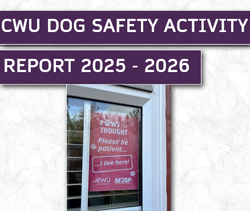
Over 200 Leaflets were handed out which convert into window stickers for community benefit to identify that a dog resides on the property.
Click on the report image to the right to see the details and of all activities the Union has been involved with in its campaign to educate the public about dangerous dogs and their responsibility to ensure their pet dog is not loose and a risk to delivery staff attending the proterty.
As an issue, Dangerous Dogs is almost ubiquetous with the CWU and both the now retired National Health & Safety Officer, Dave Joyce and Jamie McGovern as ASR Greater Mersey Amal Branch, and now as stated above working full time for the CWU; spearheading work on trade Union education about Dangerous Dogs and partnerships with both the Police and the University of Liverpool's Dog Safety Partnership and of course employers such as Royal Mail.
Nationally, Dave Joyce was called to give evidence to the House of Commons Select Committee dealing with the issue of Dangerous Dogs which in itself was prompted by lobbying from the CWU and other campaign groups.
It is worth noting how the CWU became a major vanguard of the issues concerning dangerous dogs, and at local level particularly; as can be seen with:
 The Story Behind The CWU and Merseyside Police: Dog Safety Partnership
The CWU's collaboration with Merseyside Police is one of the most significant and long-standing regional partnerships in the union's wider dog safety work.
The CWU–Merseyside Police partnership stands as a model of what coordinated, evidence-based action can achieve, combining union advocacy, academic research, NHS input, policing, and public education into a genuinely effective regional response.
The CWU's Role in the Merseyside Dog Safety Partnership
Here is a focused account of what the CWU itself specifically contributed to the partnership with Merseyside Police and the wider Merseyside Dog Safety Partnership (MDSP).
Merseyside has the highest number of dog-related injuries and deaths in the UK.
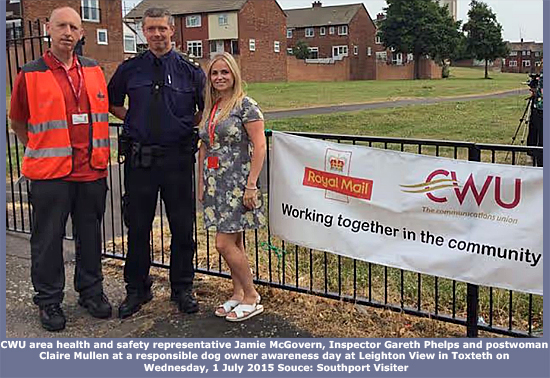
In 2015, the CWU began working with the University of Liverpool to strengthen their approach to dog bite prevention, as their postal workers were being bitten on average six times a week.
This alarming rate made Merseyside a natural starting point for developing new, collaborative solutions.
From this, the need emerged to include more organisations with different perspectives to tackle the problem, and so the Merseyside Dog Safety Partnership (MDSP) was born.
The MDSP brings together Merseyside Police, the Police and Crime Commissioner, the Blue Cross, Alder Hey Children's Hospital, the University of Liverpool, Royal Mail, the CWU, and local councils.
The partnership's goals include reducing dog bite incidents, sharing data and intelligence about dangerous dogs, educating the public and dog owners, and supporting victims of attacks. The work has been so successful that many of the collaborations and interventions developed in Merseyside have spread around the UK and even internationally.
Producing Resources for Injured Members
The CWU took responsibility for ensuring members had proper support after an attack. The leaflet "Help! I've been bitten by a dog!" was jointly produced by the CWU together with Liverpool University and the NHS, under the heading of the Merseyside Dog Safety Partnership. First published in 2021, it remains relevant and offers practical advice following a dog attack.
Supporting Members Through Branches and Safety Reps
 The CWU ensured its branch structure was central to the response. Members are reminded to always seek the direct support and assistance from their branch, including their local Workplace Safety Rep and Area Safety Rep, as being subject to a dog attack is a very distressing matter. ASRs from the North West were described as being "front and centre" in the Merseyside work and in extending its model elsewhere.
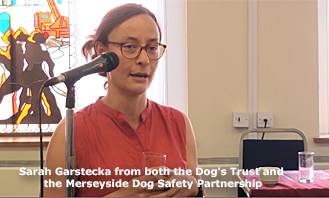
Indeed at Regional level, the Union has ensured that it's wider Union Safety REps became aware of the work being done by the MDSP, when they were invited to present at their Health & SAfety Regional Conference in 2022 - the full report with video of that presentation can be viewed by clicking on the imageright.
Exporting the Model
Perhaps the clearest sign of the CWU's ownership of this work is how it has been used as a template for other regions.
The most recent development has been a Dog Safety Partnership meeting held in Liverpool to support the setting up of an All-Wales Dog Attack Working Group, with CWU ASRs from across the North West and Wales areas front and centre in moving it forward.
CWU Wales and the Marches is now applying the Merseyside learning by developing the Wales Dog Safety Partnership — a cross-organisational way to report dangerous dogs — which has already secured support from the Welsh Government and Swansea Council and is developing across the whole of Wales.
In short, the CWU's role in Merseyside was that of an organiser, innovator and advocate — using union structures, safety reps, and partnerships to build a replicable model that has since spread across the UK.
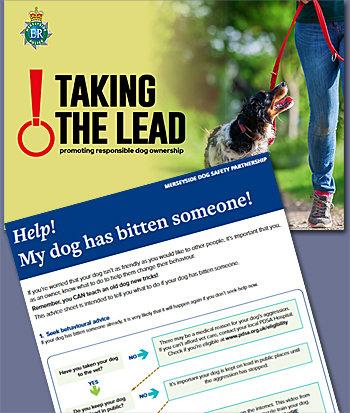 The "Taking the Lead" Campaign
One of the most visible aspects of the partnership is the Taking the Lead campaign, run jointly by Merseyside Police and the MDSP. This public-facing initiative encourages responsible dog ownership across the region, with expert video advice on preventing dog bites and keeping postal workers — and the wider community — safe.
The Postal Workers Service Level Agreement (SLA)
A major outcome of the Merseyside collaboration was the development of the Postal Workers Service Level Agreement (PWSLA), which sets out how police respond to dog attack reports from postal workers.
In autumn 2015, the SLA was piloted in five of the biggest police forces in England — the Metropolitan, Merseyside, South Yorkshire, West Yorkshire, and West Midlands — to understand demand and areas for improvement. Merseyside was therefore one of the very first forces to trial this approach.
The involvement and commitment to the PWSLA by the CWU Greater Mersey Amal Branch's Area Safety Rep, then Jamie McGovern, cannot be underestimated.
The ATLAS System
But, perhaps the most innovative output of the CWU–Merseyside collaboration is the Animal Threat Level Assessment System (ATLAS). In 2019, ATLAS was set up through joint work between the CWU and the Merseyside Dog Safety Partnership. The system is designed to build on Royal Mail's existing risk assessment process and actively encourages the engagement of both Council Dog Wardens and the Police to improve reporting of near-miss and pre-bite events involving dangerous dogs between enforcement agencies.
 An ATLAS poster with a QR code is displayed in workplaces, allowing members to simply scan the code to access a short form to report a concern about a dangerous dog.
This means potential attacks can be flagged and acted upon before a serious incident occurs — a genuinely proactive safety tool.
The Development of the ATLAS System was one of the CWU's most concrete contributions in co-creating a genuinely new safety tool. In 2019, the Animal Threat Level Assessment System (ATLAS) was set up through joint work in the Merseyside area with the CWU and the Merseyside Dog Safety Partnership. The system is designed to build on the Royal Mail Group risk assessment process and actively encourages the engagement of both Council Dog Wardens and the Police, aiming to improve the reporting of near-miss and pre-bite events with dangerous dogs between enforcement agencies.
The CWU's practical implementation of ATLAS is notable. An ATLAS poster with a QR code is displayed in the workplace and members simply scan the code to access a short form to report a concern about a dangerous dog. Once completed, the form is automatically sent to the relevant CWU Area Safety Rep, who then forwards it to the relevant Council Authority or Police Force, which should result in the Council's animal technical officer or Dog Warden responding to the hazard within 24 hours.
How the CWU Drove It
 The CWU was not simply a participant in the Merseyside partnership — it was the driving force behind it. CWU reps in Merseyside took the lead in campaigning alongside local government, Merseyside Police and Liverpool University to reduce dog attacks in Liverpool. It was grassroots union activism, led by local Area Safety Rep, Jamie McGovern; that got the partnership off the ground and kept it moving.
A Jointly Produced Public Resource
The CWU, together with Liverpool University and the NHS, jointly produced a leaflet entitled "Help! I've been bitten by a dog!" under the banner of the Merseyside Dog Safety Partnership. First published in 2021, it offers practical advice to postal workers following a dog attack.
Proven Results
The partnership has delivered measurable reductions in attacks in the region. In 2013 there were 45 dog-related incidents with postal workers in Liverpool postcodes; by 2016 this had fallen to 18, and by 2017 to 15 — a significant and promising downward trend.
You can download the MS Sway presentation of the work done this year, in PDF form from the Unionsafety E-Libraray by clicking the image on the top right above.
You can also go straight to the MS SWay website and read the document directly, here
Source: CWU / Unionsafety / MDSP /Jamie McGovern
See also: CWU North West Health & Safety Forum First Seminar Absolute Success
